

Masking at source
Health data masked where it is captured.
AI Observability
AI Observability keeps every call on record, shows which stage or tool failed, and compares each new version with the one before it, before a person decides.
Scoring
Not sampled
Trace
Prompt to tool
Audit log
Tamper-evident
Detection
During the call
Storage
In your network
The loop itself, then three scenes from the operations owner’s side: the failure with no cause, the record that names it, and the change decided on evidence.
Every call recorded, scored against the rubric, then compared.
Something failed, and nothing says which stage or which tool.
Kept with its transcript, scored after the call, then compared.
Every version change carries the comparison it was decided on.

Ask us for a walkthrough of the loop
Illustrative scene, not a product capture
Capability 1 of 4: The loop, end to end
Audio, model, tool and policy are watched on every call.
Line quality, and whether the voice is who it claims.
Signal to noise
Recognition confidence
Codec health
What the model said, how sure it was, and whether it drifted.
Hallucination detection
a confidence score from 0 to 100
LLM layer
Semantic grounding
Whether the tools answered, and how the integration held.
tool success rate on a rolling 5 minutes
tool layer
Slowest tool responses
Error chain trace
What policy allowed, what was masked, and how the brand read.
Guardrail checks
Personal data detection
Immutable audit log
detection in under 1 second across all four layers
hallucination, intent drift, grounding, slowest tool responses, integration health, PII, brand adherence
Four layers of one call, watched together
100% of calls monitored and scored, not a sample
Five product demonstrations, from the service view to the release decision, playing as the product plays on sample data.
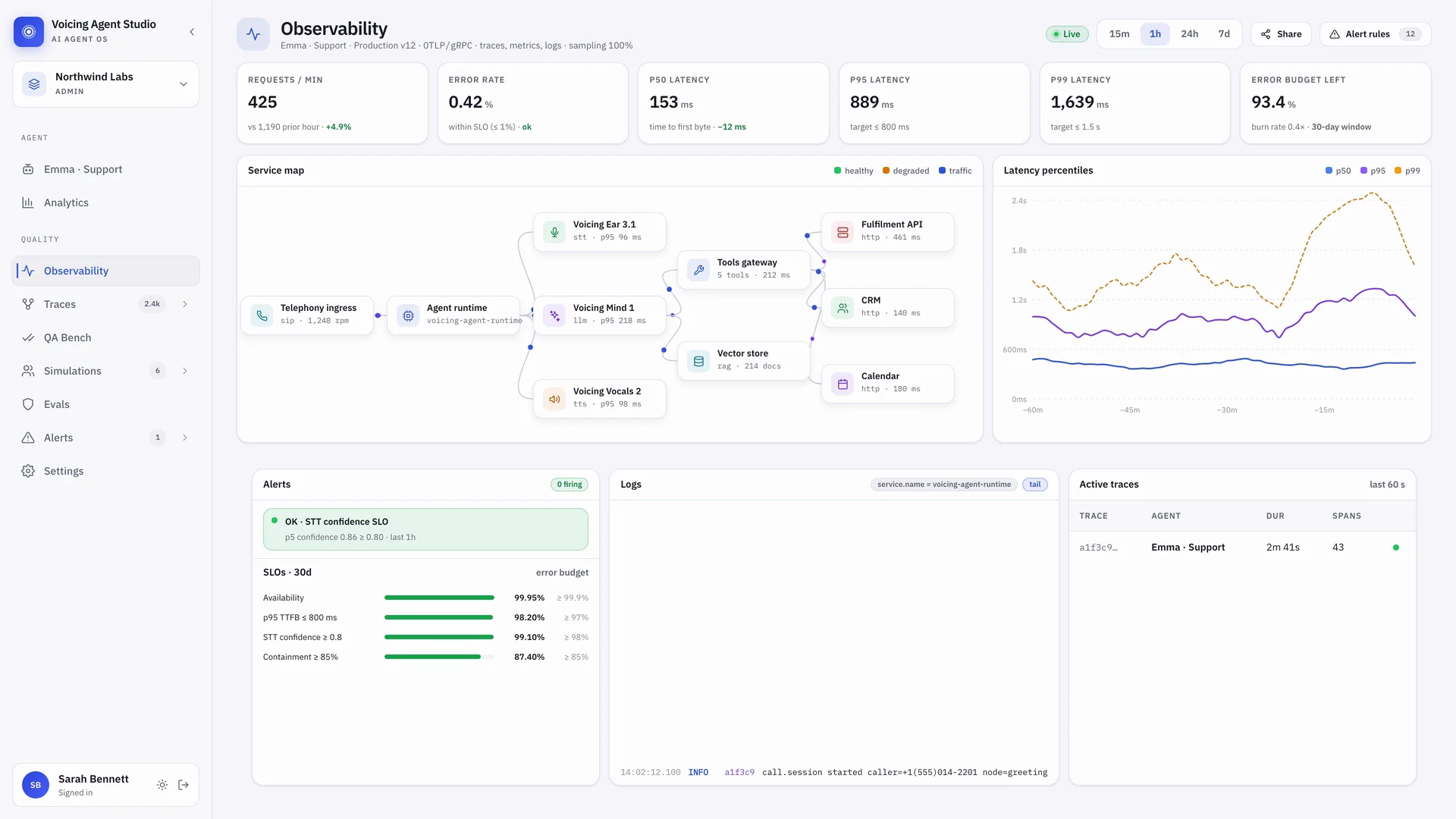
Ask us what the service view reports
Product demonstration with sample data
Capability 1 of 5: Service and health
The path after the call: records are scored against a rubric, failures are grouped by cause, and a draft version is compared with the live one before a person decides.
The record leaves the runtime in the formats your tools read.
Standard traces over OTLP.To the collector you run.
A dedicated output carries evidence.It enters the customer’s log platform.



A dedicated output carries evidence.Events map to MITRE ATT&CK.
QRadar
Included with the runtime.Covers all four layers.
Alerts follow customer-owned rules.They reach the on-call service.


A dedicated output carries evidence.It lands in the customer’s warehouse.



The record leaving the runtime for your own tools
Recordings, transcripts and traces are stored with the runtime, on your premises, in your private cloud or in Voicing Cloud; the data residency terms are settled in the architecture review.
Each regulation gets the handling that it actually asks for.
Health data masked where it is captured.
Card numbers become tokens before storage.
Signed at write, so any change is detectable.
Tracks each record to its source. Erasure reaches the source.
Each regulation keeps its own clock.
One action assembles the auditor’s pack.
The evidence pack a regulator opens
Watching every call changes what a contact centre catches.

A hospital scheduling desk on a live call
94% of issues caught before customer escalation
Detection runs on the call, not on a sample read afterwards.
measured after deploying Voicing AI Observability
67% reduction in mean time to resolution
The trace names the hop that failed, so the fix starts there.
measured after deploying Voicing AI Observability
3.2x fewer compliance audit findings
The audit log is always on, so evidence is never reconstructed.
measured after deploying Voicing AI Observability
41% reduction in LLM inference cost
Redundant tool calls are found and taken out of the path.
measured after deploying Voicing AI Observability
AI Observability
Ask us to walk through one call record and one evaluation run on your own scenarios.

Every turn traced to its cause
A working session with an engineer who has deployed inside a bank’s perimeter. We map your telephony, data boundary and handoff rules, and tell you what we would not automate.