

Speech in and out
Speech enters and leaves on one acoustic channel.
Voice AI Agents
Inbound and outbound agents that look up the record, take the permitted action and hand to a person by policy.
Function calling
97%
Response
700 ms
Hallucination
Under 0.5%
Resolution
83%
Escalation
Warm transfer
The agent at work, then three beats from the buyer’s side: where general agents stall, the core that gets past it, and the one place the agent is built, rehearsed, released and watched.
Looks up, checks policy, then acts.
Sounds done, nothing finished.
Speech, a model, your tools and data.
Every change scored before it ships.

700 ms end-to-end response latency at the 80th percentile
Illustrative scene, not a product capture
Capability 1 of 4: What the agent does
One agent from its first node to production, with every change scored against synthetic callers before it ships and every call traced after.
Product demonstration with sample data
Every stage of the runtime is timed, and published with its scope.
Transcribes the caller as they speak, accents and all, on the live stream.
<110 ms ASR processing
speech recognition stage
2.2% word error rate
speech recognition, 25+ languages
25+ languages
speech recognition with native accent understanding
Reads the request against the call so far, then chooses the tool for it.
97.2% function-calling accuracy
agentic intelligence stage
20+ turn context window
agentic intelligence stage
<0.3% hallucination rate
agentic intelligence stage
Speaks the answer, and stops the moment the caller speaks over it.
<200 ms interrupt detection
natural response stage
180 ms TTS synthesis
natural response stage
<400 ms total time to first byte
natural response stage
raw audio to action in under 400 milliseconds
three-stage pipeline, end to end
One call, from the caller’s words to the action taken
99.95% uptime SLA
Each row plays a clip of the product, from the builder to the analytics that measure it: evidence of how the story above is done.
Prompts, tools and transitions.
Speech, model, voice and turn-taking.
Synthetic callers before real ones.
The request decides which tool runs.
Lookups and permitted operations.
Every agent and its calls, one view.
Completion, containment, escalation.
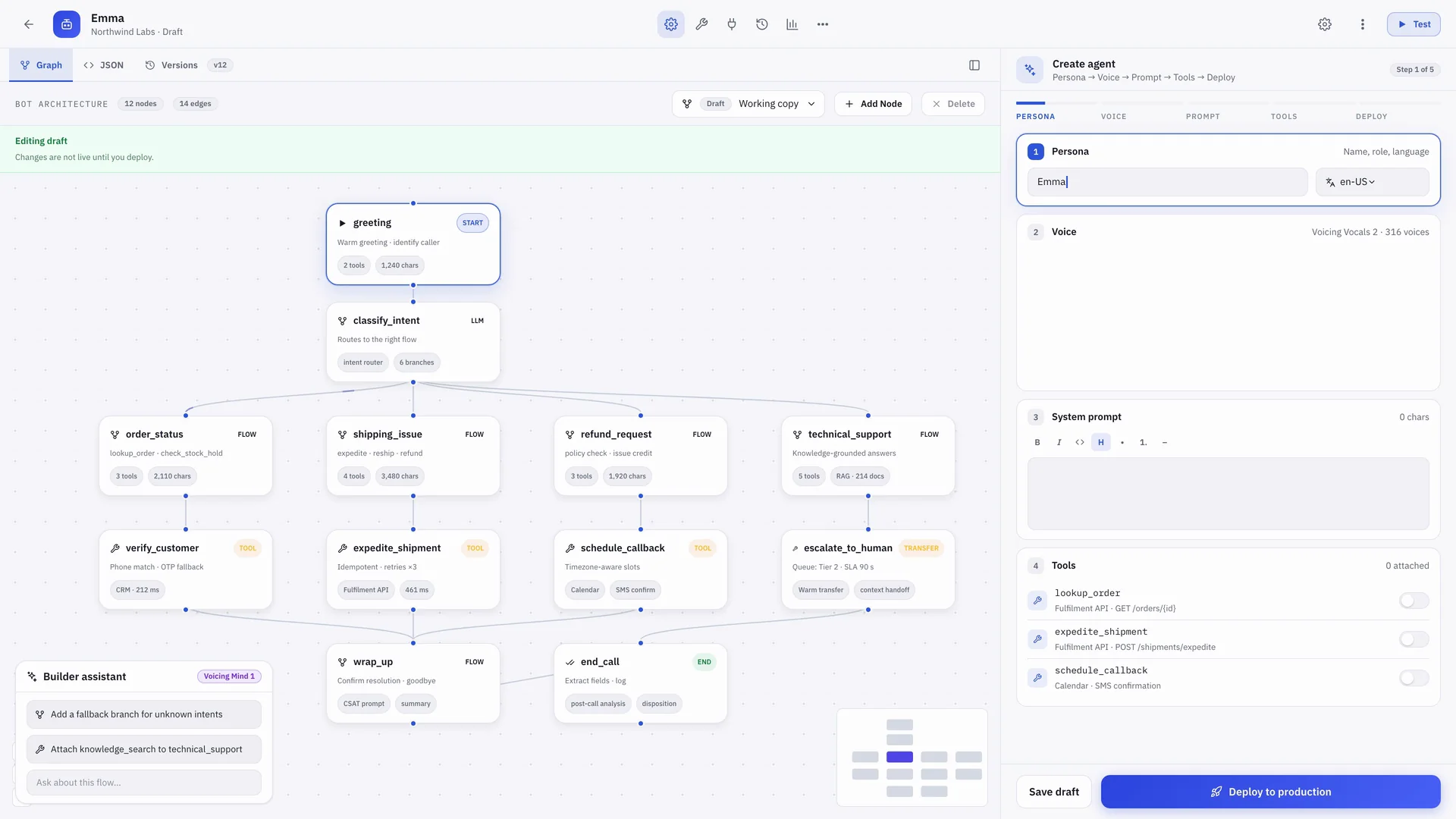
Ask us for a builder walkthrough
Product demonstration with sample data
Capability 1 of 7: Designed as a graph
A cancelled flight, one call, as an illustration. The agent names the intent, picks the rebooking tool, passes the policy check, re-issues the ticket and records a receipt. The refund goes to a person with the full context.
The parts that hold a call inside policy are named and shown.
Speech enters and leaves on one acoustic channel.
Voice and behaviour verify the caller before action.
Models can change without changing the agent contract.
The call history stays intact from turn to turn.
Policy checks every turn before tools may act.
Recovers, then hands over. The person gets the full context.
The parts that hold one call inside policy
automated QA scoring on 100% of calls, not sampled
The same agent runs on your own servers, in your cloud account or behind your own telephony, with your data inside your boundary for the life of the call.
These figures come from live deployments, with their scope.

A bank customer on the line with the agent
40-78% first call resolution improvement
The agent finishes the task on the call instead of raising a case.
live deployments across BFSI, telecom and travel
30-55% average handle time reduction against a human-only baseline
Lookups and writes happen while the caller is still speaking.
live deployments across BFSI, telecom and travel
<3 sec average response time, no queue, no hold
Every call is answered at once, with no queue and no hold music.
live deployments across BFSI, telecom and travel
<22% of calls requiring human escalation
Policy decides what the agent may do, and a person takes the rest.
live deployments across BFSI, telecom and travel
Independent Q1 2025 benchmark study, enterprise production environments
Voice AI Agents reaches your systems through their own interfaces.
Each app keeps its own interface.The runtime meets it there.








Calls enter and leave here.The runtime joins their interfaces.








Customer records stay in place.The runtime uses their own interfaces.








Cloud accounts stay customer owned.Connections use the account surfaces.







REST, GraphQL and WebSocket.Reach your own interfaces.
Webhooks and events are routed.Into your own queues.
The runtime at the centre of the systems it calls
6 weeks from contract to live

Voice AI AgentsBanking
UTI Mutual Fund
VAANI voice-first contact centre, inbound and outbound calls, since Dec 2025

Inbound and outbound, finishing the call
A working session with an engineer who has deployed inside a bank’s perimeter. We map your telephony, data boundary and handoff rules, and tell you what we would not automate.